After Ghar ki Dukaan it's time for Ghar ka App Store

Recently, Mark Zuckerberg criticized Apple’s monopolistic behavior which was somewhat ironic as he runs the one if the biggest monopolies ever created – his properties Facebook, Instagram, and WhatsApp together have more than 90% of all digital pictures. The two app stores, Apple’s App Store and Google’s Play store have been under huge criticism due to their monopolistic behavior, Epic Games, the makers of Fortnite confronted both Apple and Google and refused to pay the 30% fee that they charged to host its game on their app stores and in another case Spotify, a direct rival of Apple music, was delisted from Apple store due to disagreement on charging a fee. Paytm’s app also pulled off by the Google Play store, claiming Paytm indulged in gambling. Interestingly, Paytm is the biggest competitor of the Google Pay app in India. When we tend to think about Facebook, WhatsApp or Amazon, there are other alternatives but when it comes to the Play Store or Apple store, There is no option available. If they delisted the app, you might as well quit the business.

 Most of the time, they have been fair but when somebody launches an app that directly competes with their app, there can be some hurdles for them to succeed. Now, some apps are involving in geopolitics and become a battleground for governments.


India is open to launching its own mobile app store or expanding an existing one if it receives enough demand from domestic firms for an alternative to Apple and Google platforms, a senior government official said on Thursday.

The country has some 500 million smartphone users, most of whom use Google's Android platform, but Indian start-ups have criticised the company for policies they say stifle their growth.SoftBank-backed Paytm, one of India's leading payments firms, protested against the U.S. tech giant's decision to remove its app for a few hours last month citing violations of gambling policies.Alphabet-owned Google also said this week that it will strictly enforce a policy which will levy a 30% commission on payments made within apps on its Android store.

In response to an earlier media report, a senior Indian official told Reuters New Delhi hasn't received any formal request but was willing to consider developing a mobile platform where apps could be downloaded.

"Before we open one we need to know there will be takers for it," said the government official, declining to be named as he is not authorised to speak with media.


India already runs a mobile app store that lists over 1200 mainly government-backed applications, but also Paytm, and the government could also consider expanding that instead of starting from scratch, the official added. India's technology ministry, Google and Apple did not immediately respond to requests for comment. Google has previously said that fewer than 3% of developers with apps on its Play store sold digital goods over the last 12 months, and nearly 97% comply with its payment system policy.

Nonetheless, several Indian start-up founders are calling for a local app store that doesn't charge a high service fee.

Again a vocal for local call to start an Indian App store

"It's absolutely necessary to have a local app store," said Vishal Gondal, co-founder of Bengaluru-based gaming firm nCore Games. "If we have to give 30% fees to Google and also pay for customer acquisition, how will our budding businesses survive?"

Paytm disagreed with Google's assessment but removed certain promotions to have its app reinstated. The company's founder Vijay Shekhar Sharma has said in interviews that Google was acting as "judge, jury and executioner".

Without referring to Paytm by name, Google later said its policies were aimed at protecting users from potential harm and were applied and enforced on all developers consistently.

Fintech: The New Normal

With India becoming home to most of the Fintech start-ups is on its way to cash-less economy. Fintech are

 a group of companies offering financial services to customers with the help of technology. As per Fintech

 Adoption Index by EY one in 3 users uses at least 2 fintech services. The various tech used in  fintech are 

Artificial Intelligence, big data, machine learning, blockchain and robotic process automation. These tech 

providing assistance in different fields such as AI and machine learning helps to prevent fraudulent 

activities, data analytics helps understanding customer behaviour, blockchain provides decentralization, 

robotic process automation helps reduces human intervention. Fintech has opened many doors for 

attracting investments, giving a boost to the start-up growth in the country and already existing business 


ventures. Google-Boston Consulting group in its reports mention that digital payments and the online 

transaction will cross $500 billion by 2020. In India too three-fourth of the customer opted for digital 

mode during the pandemic. And it is forcasted that UPI that has recently broke its all time high transaction

 record, is about to overtake visa and mastercard in the coming 3 years. UPI is going offer its services 

overseas via NIPL with Rupay. Rupay which has also shown promising growth has increased its 

market share tremendously. Rupay has helped in cutting transaction cost, providing credit facility to 

small businesses, accidental insurance etc and also helped in progressing financial inclusion goal. 

Fintech in India has been promising till now although it has to adjust itself for regulatory compliances 

and the incoming Personal Data Protection Bill.

The King that gave People His Dream

On the steps of the Lincoln Memorial on August 28, 1963, Martin Luther King Jr.

presented his speech advocating for the freedom and equality of all races in front

of over 250,000 people. His “I Have A Dream” speech became widely known for

demonstrating the power of rhetoric that left an impact on America. Through the

use of allusions, metaphors, and repetition, King was able to influence Americans

to finally see that all men are created equal.

Drawing upon years of public speaking experience, King knew an emotional

speech would have greater impact upon a large, outdoor crowd rather than a

political one. By making allusions to the Declaration of Independence by citing

“life, liberty, and the pursuit of happiness” and “we hold these truths to be self evident that all men are created equal.” he was able to specifically appeal to

listeners’ patriotism. America should embody freedom and symbolize a time of

new beginnings. Although the American dream is freedom and justice and liberty

for all, it was not true for African Americans during the time. He reminds people

about the foundations and morals of which America was built upon and stresses

the importance of an individual’s human rights. He states that beneath skin color,

we are all the same. We are all human. By alluding to the Declaration, King is able

to present a beautiful and compelling vision of equality.

Dr. King uses metaphors to help explain to the audience the need for equality for

all races. He elaborates his argument about the lack of civil rights in a banking

metaphor: “America has given the N* people a bad check, a check which has come

back marked ‘insufficient funds.’ But we refuse to believe that the bank of justice is

bankrupt.” Through his metaphor he suggests that people come to America in

order to gain opportunities at a better chance at life however, people of color are

unable to do so due to the unjust laws. He himself along with other African

Americans refuse to accept this fate and abide by the unfair rules placed by people

who do not understand what it feels like to be judged before even opening their

mouth and uttering a sound. He believes that there is hope for the country and

that America has room to change and grow however, in order to so, people must

speak up. Everywhere in King’s speech, there is a demonstration of some sort of

call to action. King wants people to realize how unfair the system is and that they

should not allow for it to continue. In a nation of unjust laws, he encourages people

to rise up and demonstrate their freedom.


Throughout his speech, King repeats certain phrases such as “we can never be

satised”, “let freedom ring”, and most the most iconic “I have a dream”. The

intensity of King’s speech is built through bold statements and rhythmic repetition.

Each repetition builds on the one before and is reinforced by Martin Luther King’s

increasing passion. The phrase resonates with the listener and leaves them with

ideas that they will easily remember. As the speech comes to a close, the pace of

his repetition increases, helping to build to a crescendo.

Be the change you want to see in the world. In order for there to be a change,

people have to step up and discuss the topics that deserved to be talked about;

and that is exactly what Martin Luther King Jr. did. He was a remarkable man that

inspired thousands. He was not afraid to confront the problems at hand and gure

out ways to change them and he encouraged others to do the same. King’s words

and actions were able to make a mark in America and change history. His message

of equality is still heard in our society today.

Protesting at the same place where MLK gave the speech


The voice still resonates around and is giving to power to movements like Black Lives Matter #BLM

SMART(ER) Goal Setting

 Goals are the specific result or purpose expected from the project. The project goals specify what will be accomplished over the entire project period and should directly relate to the problem statement and vision. The goal is achieved through the project objectives and activities.


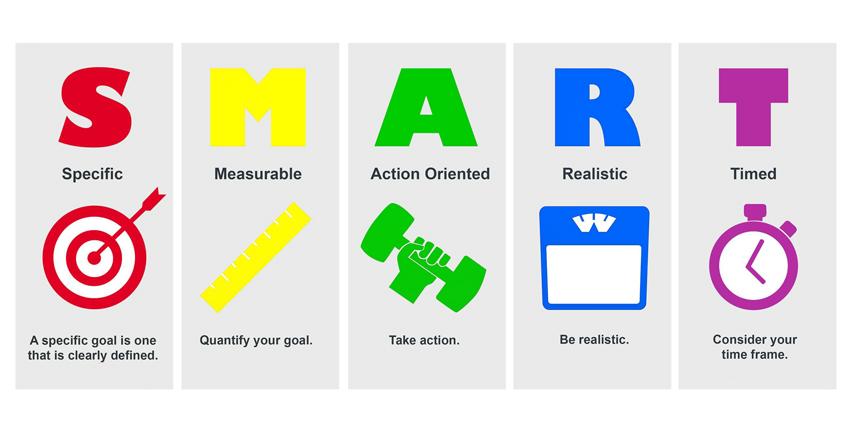
Objectives are the specific steps that lead to the successful completion of the project goals. Completion of objectives results in specific, measurable outcomes that directly contribute to the achievement of the project goals. Setting specific, measurable, achievable, relevant, and time-bound (SMART) objectives is a good way to plan the steps to meet the long-term goals in your grant. It helps you take you from ideas to action. Setting SMART objectives keeps the project moving forward, helps with accountability and timing, and lets you know that you are accomplishing what you set out to accomplish. 


The aim of SMART goals is to create realistic goals that produce an outcome. Often when setting goals, people will think big and get discouraged if they don’t meet their goals. While the College encourages our registrants to think big, we also want to ensure registrants are creating achievable goals with practical results. The process is not meant to be daunting or overwhelming.


Goal setting will be different for everyone, but it always provides focus and direction, no matter what you are trying to accomplish.


Definition of SMART Objectives

SMART stands for specific, measurable, achievable, relevant, and time-bound


Specific – Objective clearly states, so anyone reading it can understand, what will be done and who will do it?

Measurable – Objective includes how the action will be measured. Measuring your objectives helps you determine if you are making progress. It keeps you on track and on schedule

Achievable – Objective is realistic given the realities faced in the community. Setting reasonable objectives helps set the project up for success

Relevant – A relevant objective makes sense, that is, it fits the purpose of the grant, it fits the culture and structure of the community, and it addresses the vision of the project.

Time-bound – Every objective has a specific timeline for completion. 


The Importance of SMART Goal Setting

How To Set Goals: Tips and Tricks for Setting Goals | Grammarly


Often, individuals or businesses will set themselves up for failure by setting general and unrealistic goals such as “I want to be the best at X.” This goal is vague, with no sense of direction.

SMART goals set you up for success by making goals specific, measurable, achievable, realistic, and timely. The SMART method helps push you further, gives you a sense of direction, and helps you organize and reach your goals.

How to Set Goals You Can Achieve This Year

Now the theory is evolving and is the need of time to also evaluate and reward yourselves and create a proper feedback loop for getting the best approach to fulfill your goals. 

Be S.M.A.R.T.E.R


Mahamandi Video NITIE 2020


Jodhpur Sandstone, used extensively in several regional heritage buildings in north-western India, geologically belongs to the Ediacaran-Cambrian age Marwar Supergroup. The Marwar Supergroup has been subdivided into Jodhpur (arenaceous facies), Bilara (carbonate facies) and Nagaur (argillaceous facies) groups (in stratigraphically ascending order). The brown, red, pink and creamish pink varieties of Jodhpur Group Sandstone are the most preferred dimension stone varieties, excavated from several open quarries in the region between Jodhpur and Satrava in western part of Rajasthan State, NW India. 

The region has an old quarrying history, dating back to the use of sandstone in the fourth century temples in Mandor, eighth century Osian Temple Complex (also called as Khajuraho of Rajasthan for its intricate carvings in sandstone) and several historic monuments, such as Mandore Fort, Royal Tombs at Mandore Garden, Mehrangarh Fort, Clock Tower, Jaswant Thada, Umaid Bhawan Palace, etc. Several present day institutions/corporate houses of national eminence, such as the Rajasthan High Court, Indian Institute of Technology (Jodhpur), All India Institute of Medical Sciences (Jodhpur), Umaid Heritage Residential Complex and Hotel Radisson (Jodhpur) etc. exemplify continued use of Jodhpur Sandstone in contemporary times. Buildings of the Karachi Municipal Corporation and Karachi Chamber of Commerce and Industry in southern Pakistan attest to the international usage of Jodhpur Sandstone. The Jodhpur Sandstone can be classified as ‘quartz arenite’ comprising rounded to sub-rounded quartz grains with ferruginous cement. Its mature, mineralogy and moderate to high endurance, resistance to weathering, etc., render it suitable for intricate carving. Owing to these characteristics and its aesthetic appeal, it is used in a range of artefacts and handicrafts within India and overseas. 

The Jodhpur Sandstone fulfils the criteria laid down by the Heritage Stone Sub-commission for designation as a Global Heritage Stone Resource and we propose a case for its consideration and accreditation as a Global Heritage Stone Resource from India.


So we tried to populrize our product through posters and video campaigns and help our miners and artisans get rewarded for their art work. Above is a video made for NITIE Mahamandi for the Vocal for Local campaign and pushing our products globally because they deserve it.


Economics: FCRA 2020, Will do more Bad than Good

 The Foreign Contribution (Regulation) Bill(FCRA) 2020, have been passed in both houses of the parliament, waiting for the President's approval on some of the aspects. Such as capping administrative expense financed through foreign donation, mandatory account opening in SBI Delhi Branch, banning the transfer of grants recieved under FCRA Act to other outfits, giving power to Ministry of Home Affair to cancel the FCRA certificate of NGOs. All this are being done to NGOs when we need them the most, to fight the pandemic. These provisions make NGO susceptible to pressure from above. Nearly 20,000+ NGOs are currently registered under FCRA Act, contributing in wide range of works. They have been key in linking the gap between government programmes and beneficiaries. Many smaller NGOs at grassroots level have helped fighting the virus which would not have been possible without the support of bigger NGOs who in turn driven by foreign donations. This would not have been possible under the current bill. The experience these NGOs get while working at grassroot enables them to see loopholes in government programmes and sometimes makes them ask difficult questions. Questions related to discrimination, violation of human rights etc. Thanks to these criticism some of the finest laws have been born in the countries for example- Environmental protection law, Right to Education, Right to Information etc. The current intervention might disturb the freedom and firepower these NGOs have and eventually disabling the democracy at large.

Self-Fulfilling Prophecy And The Pygmalion Effect In Management

So what even is Pygmalion Effect?


Robert Rosenthal defined the Pygmalion effect as “the phenomenon whereby one person’s expectation for another person’s behavior comes to serve as a self-fulfilling prophecy

The Pygmalion Effect explains that people tend to perform up to the level that others expect of them.

The Pygmalion phenomenon describes numerous leader-follower connections. The "leader" can be an administrator or boss, a military leader, an athletic mentor, or an educator. At the point when leaders' desires for their supporters are raised, they act in manners that cause their supporters, be they representatives, officers, competitors, or learners, to perform better. Pygmalion impacts have been delivered in schools, work associations, armed forces, courts, day camps, and nursing homes, just as in the act of clinical therapists and specialists.


Leader-Follower Disconnect. I have always been fascinated with the… | by  Olaoluwa Awojoodu | Medium

Many parents know that teachers’ expectations about individual children often become self-fulfilling prophecies: that is if a teacher believes a child is slow, the child will come to believe that, too, and will in fact learn slowly. The lucky child who strikes a teacher as sharp also picks up on that expectation and will rise to meet it. This finding has been confirmed so many times, and in such different settings, that it’s no longer even debated.

The powerful influence of one person’s expectations on another’s behavior has long been recognized by physicians and behavioral scientists and, more recently, by teachers. But heretofore the importance of managerial expectations for individual and group performance has not been widely understood.

Case Studies:

Self-Fulfilling Prophecies.

The “average” unit, however, proved to be an anomaly. Although the district manager expected only average performance from this group, its productivity increased significantly. This was because the assistant manager in charge of the group refused to believe that she was less capable than the manager of the superstaff or that the agents in the top group had any greater ability than the agents in her group. She insisted in discussions with her agents that every person in the middle group had greater potential than those in the superstaff, lacking only their years of experience in selling insurance. She stimulated her agents to accept the challenge of outperforming the superstaff. As a result, each year the middle group increased its productivity by a higher percentage than the superstaff did (although it did not attain the dollar volume of the top group).

Pattern of Failure.

When salespersons are treated by their managers as super-people, as the superstaff was at the Metropolitan Rockaway district office, they try to live up to that image and do what they know supersalespersons are expected to do. But when the agents with poor productivity records are treated by their managers as not having any chance of success, as the low producers at Rockaway were, this negative expectation also becomes a managerial self-fulfilling prophecy.

Course Forward:

Managers not only shape the expectations and productivity of subordinates but also influence their attitudes toward their jobs and themselves. If managers are unskilled, they leave scars on the careers of young people, cut deeply into their self-esteem, and distort their image of themselves as human beings. But if they are skillful and have high expectations, subordinates’ self-confidence will grow, their capabilities will develop, and their productivity will be high. More often than one realizes, the manager is Pygmalion.

Malnutrition: The Silent Pandemic

One-third of world stunned children below age 5 and half of wasted children belong to India. It results in

high mortality among these children and disability and affects future generation intellectual capability and 

human capital. Covid-19 will and have added insult to the injury, it is estimated to add minimum 10,000 

deaths in the coming six months of children below age 5. Dietary intake and underlying diseases are the 

direct reason behind malnutrition coupled with many indirect factors like food insecurity, low maternal 

education,poor access to health care services, access to clean drinking water and poor hygiene. Some of 

our great tools to fight malnutritions and impart education like Mid-day meal scheme got hampered during 

the lockdown, pushing our fight against malnutrition further back. Some immediate steps need to be taken 

to put it back on track such as: deciding on a core indicator to review progress, using local available high 

nutritious food, specially taking care of young and infant childrens, take home ration system, making child 

specific schemes like PMMVY, PMGKAY reach the last mile, efficient PDS system and making use of 

technology to better manage and monitor progress. Additionally not only nutrition specific interventions 

will do the job we need to implement nutrition specific plus complementary nutrition specific intervention.


CUSTOMER IS GOD...... or NOT?

CUSTOMER IS GOD 
or is he not now?

Customer is king and is the bread giver. Customer rules the market. Today we are living a buyer’s world or market. Customer dictates the terms and conditions of sale. The focus//pivot of all the marketing policies and strategies is the customer. If customer is there banks, offices and factories are there. Without customer all business will come to standstill. In the great congress / meeting of great marketing and management minds this has been concluded that customer is the key base to all the developments and advancements in the world. There is market and there is demand because of customer. Take care of customer failing which you may run the great risk of loss of business.

"Customer is the king"...... "Customer is the god".... this was a mind set that had been cultivated in many organisations, specially when it comes to front office customer servicing staff and sales staff.
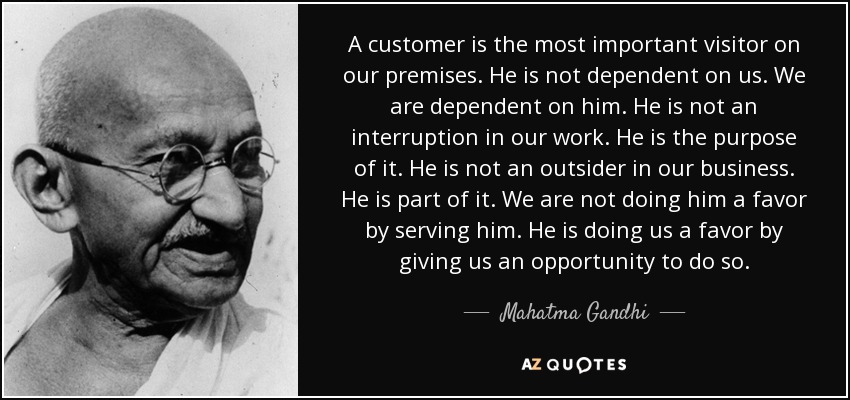
Mahatma Gandhi quote: A customer is the most important visitor on our  premises...
The customer is not God but the customer has the money. We want the money. We have no other reason to be in business. So we want to show the customer goods or services they want to buy. We say “The customer is always right.” Even when they are wrong. There is only so much ass-holery we should put up with from customers, particularly in defense of our sales staff. Some customers want to heap abuse on our personnel. No amount of money is worth that.

Now the reason why the saying is outlived is because the world is becoming more and more complex and it is no longer realistic to expect that customers understand what they really NEED. As such, the role of the provider (vendor, shop owner...) is to analyze the customers' needs and suggest which product would best fit those needs.

But to do so, you need to become a partner of the customer, and not a servant who mindlessly fulfills commands.

Blog Archive